Our services
Engine and mechanical repair in Tilburg
Repair starts with the cause, not with the part closest to the complaint. We first establish what is actually wrong, then give you a quote, and only then start work.
Strange noise, smoke or a leak?
Send a photo of the spot where it leaks, or a short video with the noise audible. From a recording like that we can often already hear and see which way it points — and whether it can wait or you had better stop driving.
Send a photo or videoWhat we repair
- Timing — belt or chain, with tensioners and water pump where the specification calls for it.
- Cooling system — water pump, thermostat, radiator, hoses, and assessment of the head gasket when coolant disappears.
- Turbo and EGR — power loss, limp mode, soot and smoke.
- Injection and ignition — injectors, coils, spark plugs, glow plugs.
- Clutch and gearbox — slipping, heavy shifting, automatic transmission faults.
- Suspension and steering — shock absorbers, springs, control arms, ball joints, wheel bearings.
- Exhaust — welding, mountings, a particulate filter that will not regenerate.
- Electrical faults — earth problems, charging system, starting problems.
- Welding on load-bearing parts, including for the APK.
Cause first, repair second
Power loss can come from the turbo, but just as easily from a blocked particulate filter, a leaking boost hose or a sensor reporting wrong values. Replace the turbo straight away and you risk keeping the complaint while the invoice is already paid.
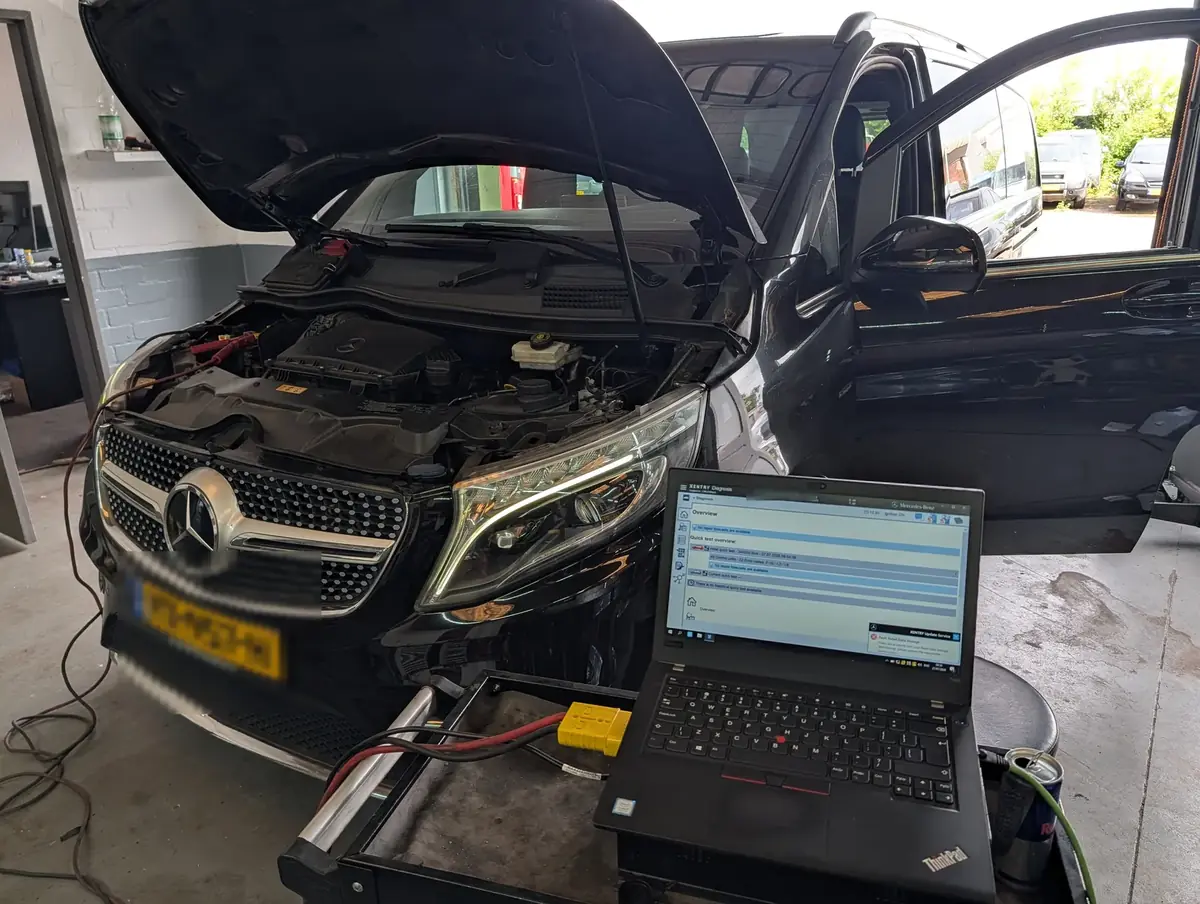
So we first read out all control units, look at live measured values and measure on the car itself. Only once it is clear what has failed do you hear what the repair involves and what it costs.
When to come in
- Power loss or limp mode.
- A noise that follows engine speed, or road speed instead.
- Coolant disappearing without a visible leak.
- Blue, white or black smoke from the exhaust.
- Starting problems, or the engine cutting out while driving.
- An oil patch under the car.
What you can expect from us
- A quote before the repair. If something extra comes up during the work, we call you first.
- Explanations in plain language about what has failed and why.
- A distinction between now and later — what affects safety and what can wait.
- Brand-specific diagnostics for nine makes with original factory software; fault finding and repair for every make.
Five complaints we start with
These are the complaints cars most often come in with. For each one you can see what we measure first and what it usually turns out to be — so you know what will happen before you hand over the key.
- Power loss or limp mode. We read the engine control unit and look at boost pressure, air mass and the pressure difference across the particulate filter. It often turns out to be a clogged filter that no longer regenerates or a leaking charge-air hose — not the turbo itself.
- Smoke from the exhaust. The colour sets the direction: blue, white and black each point somewhere else. What each colour means is in exhaust smoke and what the colour means.
- Coolant disappearing. We pressurise the system and look for the leak before anyone starts talking about a head gasket. See coolant disappearing without a visible leak.
- Noise from the engine bay. Does it follow engine speed or road speed? That distinction decides whether we look at the timing drive, the drivetrain or the wheel bearings. On some engines the timing chain is a known weak point.
- Heavy steering. Before anyone replaces a pump, we check the fluid level and condition, the drive belt and — on electric systems — the control unit and its power supply. See steering that feels heavy.
From complaint to invoice — four steps
- Your account of it. When does it happen — cold or warm, standing still or under load? That shortens the search, and search time costs money.
- Reading out and measuring. All control units, live values, and where needed a measurement on the car itself.
- Quote. You hear what is broken, what the repair involves and what it costs. Only then do we start.
- Repair and check. Afterwards we read out again, and we clear the fault codes only once the cause is gone — clearing is not repairing.
What to note down before you come
A fault that only shows up now and then will not always appear on the lift. The sharper your observation, the shorter the search.
- At what temperature: cold start, or only after twenty minutes of driving?
- Under what load: idling, accelerating, at steady speed, or on the overrun?
- Since when, and did anything come before it — a repair, a fill-up, heavy rain?
- Which lights come on, and do they stay on or go out again? See what the lights on your dashboard mean.
- A sound recording on your phone often says more than a description.
Timing belt replacement
The timing belt keeps the crankshaft and camshaft in sync. The replacement point is in your engine's service schedule, in kilometres and years – a belt also ages when you drive little. If it breaks, valves and pistons collide on many engines: then it is no longer a belt job but engine damage. We replace the belt with tensioner, idlers and, where the schedule requires it, the water pump. The price differs a lot per engine; you hear it up front by registration.
On some engines the belt runs in oil, such as the PureTech 1.2 and the Ford 1.0 EcoBoost; there the right oil and interval matter even more. Engine with a chain, like the BMW N47 and N57? Read how to spot chain wear.
Frequently asked questions
Do you also repair older cars with high mileage?
Yes. That is exactly where it pays to establish first what has actually failed, so you do not invest in the wrong part.
Can I get a quote before anything happens?
Always. We do not start a repair without you knowing what will be done and what it costs.
My car has broken down. What now?
Call or message us with the problem and the registration. We will tell you whether it makes sense to drive it in or whether it is better towed.
Do you also do welding for the APK?
Yes, we weld load-bearing parts in our own workshop. The inspection itself then takes place at an RDW-approved test centre.
How long does a repair take?
That depends on what is broken and whether the parts are in stock. You hear it with the quote, together with the cost — not once the car is already apart.
Which parts do you use?
Parts that meet the manufacturer’s specification. Where there is a choice, we discuss it before the repair, not after.